

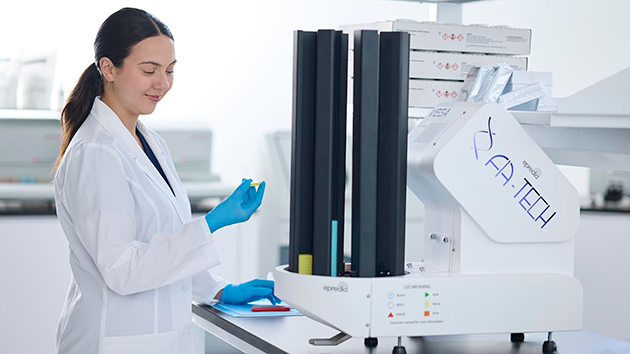

Enhance Traceability

Include up to 100 characters in 2D barcodes for enhanced sample identification. Epredia laser cassette printers requires no consumables such as print heads, ink cartridges, ribbon, or UV fixing lights to generate high-resolution, 600dpi print on the face of the cassette.

Resources

Brochures (AMER)

PDF Product

Documentation Open manufacturer product resources ↗

PDF Product

Documentation Open manufacturer product resources ↗

PDF Product

Documentation Open manufacturer product resources ↗

Resources

Brochures (EMEA/APAC)

PDF Product

Documentation Open manufacturer product resources ↗

PDF Product

Documentation Open manufacturer product resources ↗

PDF Product

Documentation Open manufacturer product resources ↗

Product Video

See the product and workflow in action

A dedicated video area gives the product page the same richer media experience expected from a modern scientific catalogue.

Universal

See High Resolution Printing in Action​

Frequently Asked Questions

Product FAQs

Common technical and purchasing questions can be answered directly on the product page, reducing unnecessary navigation.

What is Cassette Printing?

Cassette printing in histology includes marking the cassette with identifiable information to be able to trace the sample throughout the tissue processing, embedding and microtomy process.

Cassette traceability is critical in the histology workflow so that samples are labeled and tracked throughout the entire process, from grossing to archiving. Having a high quality, printed barcode can help support workflow improvements, including high scan rates at downstream instruments such as slide printing and archiving​.


Infrared laser printers use a YAG laser to print in the IR spectrum of light. Ultraviolet laser printers use UV wavelengths to mark on cassettes. Epredia’s infrared laser in its Vega and Nova laser cassette printers has been validated to print on Epredia laser cassettes with 600 dpi resolution, enabling labs to print more information in their barcodes compared to thermal transfer printing.​


It is designed for molar quantification of sequencing-ready NGS libraries before sequencing, using fluorescence-based detection.

Vision Diagnostic

Bring Xenium to your laboratory.

Talk to our scientific and technical team about product selection, panels, applications, pricing and implementation support.


Prepare library

Generate sequencing-ready NGS library material.

Prepare library

Generate sequencing-ready NGS library material.

Prepare library

Generate sequencing-ready NGS library material.

Prepare library

Generate sequencing-ready NGS library material.

Send us an enquiry

Our team will review your request and connect you with the relevant specialist.