
Desalting Spin Columns and Products
Desalting Spin Columns and Products
Zeba desalting columns and plates size-exclusion chromatography products are used in research applications that involve the separation of proteins, and other macromolecules from soluble low molecular weight substances (e.g., salts) that may adversely impact the stability of the analytes or interfere with downstream applications. Zeba desalting products are also used in protein buffer exchange to more appropriate buffers before subsequent applications such as western blotting, immunoprecipitation, activity assays, and mass spectrometry.
Desalting format selection guide
| Format | Desalting Spin Columns | Desalting Spin Plates | Desalting Chromatography Cartridges |
|---|---|---|---|
| Sample volume range | 2 μL–10 mL | 20–100 μL | 15–250 μL |
| Resin bed volume | 75 μL–20 mL | 550 μL | 1 mL–5 mL |
| Resin molecular weight cut-off (MWCO) | 7 kDa, 40 kDa | 7 kDa, 40 kDa | 7 kDa |
| Automation-compatible? | No | Yes | Yes |
| Products |
7K 40K |
2 96-well filter plates 4 96-well filter plates |
1 column x 5 mL 5 columns x 1 mL |
Thermo Scientific Zeba Spin Desalting Columns are made of low protein-binding polypropylene and are compatible with a wide range of standard laboratory instruments and consumables.
Our Zeba columns are designed for use with most swinging-bucket or fixed-angle bench- or floor-model centrifuges (please verify head clearance before use) and are available in six volume capacities and two molecular weight cut-offs (MWCOs), 7K and 40K.
The MWCO should be lower than the molecular weight of the target molecule to help ensure it is retained while contaminants are reduced. Columns with 7K help provide finer resolution for smaller molecules, useful for purifying smaller proteins (e.g., cytochrome c) or peptides (e.g., insulin). Columns with 40K are better suited for large proteins (e.g., BSA), protein complexes (e.g., hemoglobin) and large enzymes (e.g,. pyruvate kinase).
Size exclusion desalting spin column with 7K MWCO selection guide
| Micro Desalting Spin Column, 7K | 0.5 mL Desalting Spin Column, 7K | 2 mL Desalting Spin Column, 7K | 5 mL Desalting Spin Column, 7K | 10 mL Desalting Spin Column, 7K | 20 mL Desalting Spin Column, 7K | |
|---|---|---|---|---|---|---|
| Sample volume | 2–12 µL | 30–130 µL | 200–700 µL | 500–2,000 µL | 700–4,000 µL | 4,000–10,000 µL |
| Resin bed volume | 75 μL | 0.5 mL | 2 mL | 5 mL | 10 mL | 20 mL |
| Product type | Micro Spin Column | 0.5 mL Spin Column | 2 mL Spin Column | 5 mL Spin Column | 10 mL Spin Column | 20 mL Spin Column |
Size exclusion desalting spin column with 40K MWCO selection guide
| Micro Desalting Spin Column, 40K | 0.5 mL Desalting Spin Column, 40K | 2 mL Desalting Spin Column, 40K | 5 mL Desalting Spin Column, 40K | 10 mL Desalting Spin Column, 40K | 20 mL Desalting Spin Column, 40K | |
|---|---|---|---|---|---|---|
| Sample volume | 5–14 µL | 70–200 µL | 200–900 µL | 300–2,000 µL | 1000–4,000 µL | 4,000–10,000 µL |
| Resin bed volume | 75 μL | 0.5 mL | 2 mL | 5 mL | 10 mL | 20 mL |
| Product type | Micro Spin Column | 0.5 mL Spin Column | 2 mL Spin Column | 5 mL Spin Column | 10 mL Spin Column | 20 mL Spin Column |
Zeba desalting column product performance
Zeba Spin Desalting Columns are designed to provide exceptional desalting and buffer exchange capabilities for quality results in your protein purification workflows. These columns utilize a resin technology that allows for efficient separation of salts and small molecules from proteins, offering high recovery rates and fast processing times. With their user-friendly spin format, Zeba columns facilitate quick and convenient sample processing while maintaining protein integrity and activity. Explore our performance data below.
Volume capacity
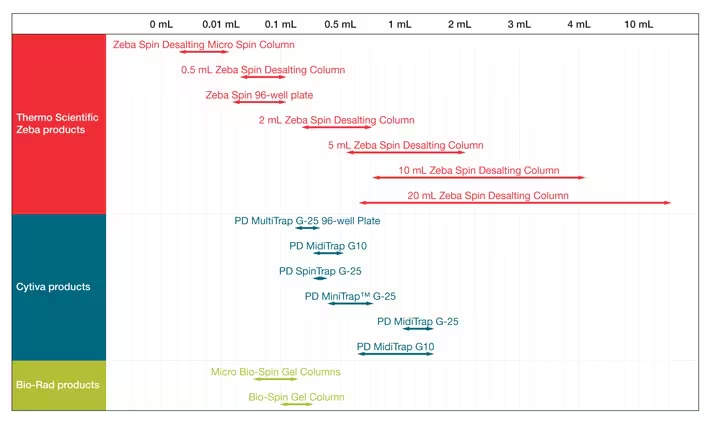
Zeba Spin Desalting Columns are available in a variety of sizes and volume capacities compared to competitor offerings (Figure 1). Zeba columns can also be used with volumes as small as 5 µL (in micro format) to as large as 10 mL.
Protein recovery
Zeba 40K Spin Desalting Columns contain an enhanced high-performance size-exclusion chromatography resin. These redeveloped Zeba columns demonstrate improved protein recovery for a variety of proteins in the 40 kDa and above molecular weight range (Table 1).
Protein recovery comparison using Zeba Protein Desalting Columns with 7K and 40K MWCO resin.
| Recovery* | |||
|---|---|---|---|
| Protein | Molecular Size | 7K Zeba Column | 40K Zeba Column |
| Bacitracin | 1.5 kDa | 15% | 12% |
| Aprotinin | 6.5 kDa | 58% | 37% |
| Ubiquitin | 8.5 kDa | 78% | 51% |
| Lactalbumin | 14 kDa | 88% | 64% |
| Trypsin Inhibitor | 21 kDa | 94% | 76% |
| Carbonic Anhydrase | 30 kDa | 90% | 79% |
| Ovalbumin | 42 kDa | 95% | 95% |
| BSA | 67 kDa | 94% | 93% |
| Rabbit IgG | 150 kDa | 92% | 92% |
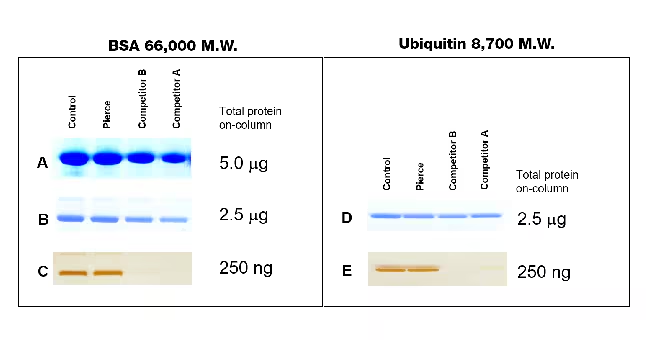
Zeba 7K Spin Desalting Columns contain a high-performance size-exclusion chromatography resin that allows for exceptional protein desalting and recovery. When compared to competitors, Zeba 7K desalting columns have excellent protein recovery even at dilute protein concentrations
Zeba Micro Spin Desalting Columns, 7K MWCO, recovery performance. BSA and ubiquitin samples of varying concentrations were processed using Zeba Micro Spin Desalting Columns, 7K MWCO, alongside comparable competitor products.
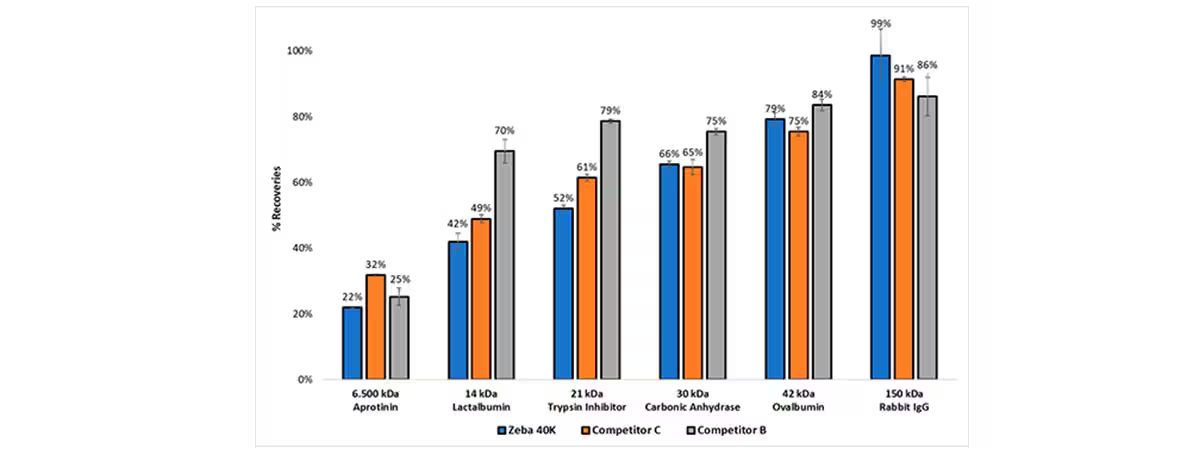
Purified protein samples (0.5 mg/mL) of varying molecular weights were applied individually in 50 µL aliquots in either 0.5 mL Zeba 40K, Competitor C, or Competitor B spin columns equilibrated in PBS. Columns were centrifuged per manufacturers’ instructions for each resin, and the recovered protein (%) in each flow-through sample was determined by BCA protein assay. As opposed to competitor columns, the Zeba 40K resin was more efficient at reducing smaller proteins (evidenced by the lower small protein recovery values).
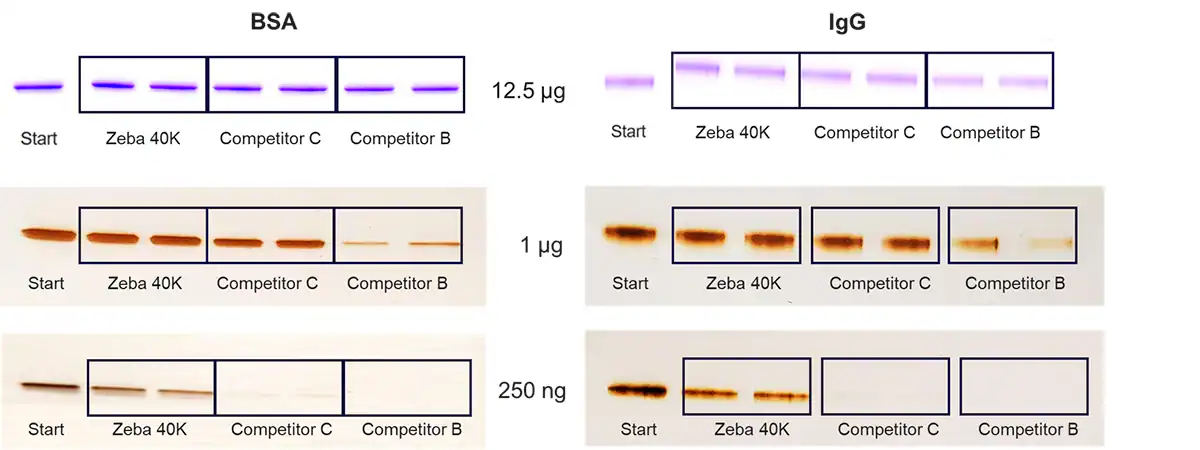
Exceptional sample recovery of low protein loads with Zeba 40K spin columns. BSA and IgG of varying concentrations were applied in 50 µL aliquots to either 0.5 mL Zeba 40K, competitor C, or Competitor B spin columns. All columns were equilibrated with PBS, then centrifuged per manufacturers’ instructions for each resin. Recovered protein (%) in each flow through sample was determined by BCA assay. Flow through samples were performed on SDS-PAGE and stained with either Coomassie Blue or silver stain. Although 12.5 µg total protein load was recovered efficiently by all three resins, lower recoveries were observed with competitor resins at 1 µg and 250 ng protein loads.