


Generate sequencing-ready NGS library material.


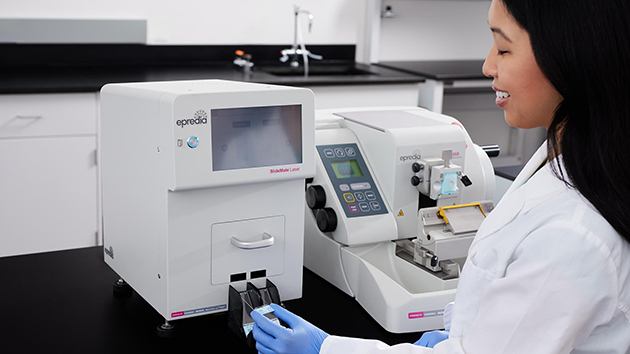
Printing directly on slides using SlideMate printers can help support tracking pathology specimens in the laboratory for the life of the sample. Epredia offers laser and thermal transfer slide printing options to accommodate many workflow options.

Documentation Open manufacturer product resources ↗

Documentation Open manufacturer product resources ↗

Documentation Open manufacturer product resources ↗

Documentation Open manufacturer product resources ↗

Documentation Open manufacturer product resources ↗

Documentation Open manufacturer product resources ↗
Slide printers are used in histology and cytology to print information about the specimen and patient directly onto the slide. This supports sample traceability throughout the life of the slide, from microtomy through staining, digital pathology and archiving.
On-demand slide printing occurs when slides are printed directly at the time of microtomy as opposed to batch printing when a set of slides are pre-printed and sorted through.
Printing information directly onto the slide eliminates the possibility of adhesive residue of labels releasing from the slide during the staining process.
Microscope slides designed for thermal transfer slide printing generally have a smoother surface for the print head to come in contact with and transfer ink to the surface of the slide. A rough surface, like many standard slides have, may require higher heat settings and could cause ribbon tearing and incomplete data transfer to the slide tab.
Talk to our scientific and technical team about product selection, panels, applications, pricing and implementation support.
Generate sequencing-ready NGS library material.

Our team will review your request and connect you with the relevant specialist.
Single cell multiomics for thousands of samples and billions of cells, even from FFPE.
Scalable whole transcriptome spatial at subcellular resolution.
Our monthly insights for strategic business perspectives.