
Restriction  Endonucleases

Product Overview​

The Leader in the Discovery and Production of Restriction Enzymes

With over 45 years of offering restriction enzymes to the research community, NEB has earned the reputation of being a leader in enzyme technologies. Working continuously to be worthy of that distinction, NEB strives to develop enzymes of the highest purity and unparalleled performance.

NEB scientists continue to improve its portfolio of restriction enzymes, as well as explore their utility in new technologies. As a result, NEB scientists continue to publish scientific papers and to be awarded grants in this area. With the industry’s largest research and development group dedicated to restriction enzymes, we are proud to have been there first: the first to commercialize a recombinant enzyme, the first to introduce a nicking enzyme. In addition, NEB has an ongoing history of innovation by engineering restriction enzymes with altered specificities and improved performance. Through continued research in these areas, we are committed to driving the innovations that allow us to offer maximum convenience and performance. 

The Leader in the Discovery and Production of Restriction Enzymes

With over 45 years of offering restriction enzymes to the research community, NEB has earned the reputation of being a leader in enzyme technologies. Working continuously to be worthy of that distinction, NEB strives to develop enzymes of the highest purity and unparalleled performance.

NEB scientists continue to improve its portfolio of restriction enzymes, as well as explore their utility in new technologies. As a result, NEB scientists continue to publish scientific papers and to be awarded grants in this area. With the industry’s largest research and development group dedicated to restriction enzymes, we are proud to have been there first: the first to commercialize a recombinant enzyme, the first to introduce a nicking enzyme. In addition, NEB has an ongoing history of innovation by engineering restriction enzymes with altered specificities and improved performance. Through continued research in these areas, we are committed to driving the innovations that allow us to offer maximum convenience and performance.

For details on NEB’s quality controls for restriction endonucleases, visit our Restriction Enzyme Quality page.

[DNA thumbnail] Cut Smarter with Restriction Enzymes from NEB®


All of NEB's Restriction enzymes have transitioned to a new buffer system. Visit NEBCutSmart.com  for further details.


Convenience

  • >210 restriction enzymes are 100% active in a single buffer – rCutSmart™ Buffer.
  • >180 restriction enzymes are Time-Saver qualified, meaning you can digest DNA in 5-15 minutes, or digest DNA safely overnight.
  • Choose from > 265 restriction enzymes, the largest selection commercially available.

[DNA thumbnail] View the Activity/Performance Chart for NEB® Restriction Enzymes


Performance

  • Choose a High-Fidelity (HF®) restriction enzyme, which has been engineered for reduced star activity, rapid digestion (5-15 minutes) and 100% activity in rCutSmart Buffer. A vial of 6X Purple Loading Dye is included with most restriction enzymes.
  • All of our restriction enzymes undergo stringent quality control testing, ensuring the highest levels of purity and lot-to-lot consistency.


    Physical Purity Enzymes are evaluated for purity to ensure the highest levels of purity and the absence of contaminating proteins.
    DNA Contamination Enzymes are screened by qPCR to ensure no contaminating genomic DNA is present. The specification for this assay is less than one E.coli genome per sample.
    Exonuclease Activity Using radioactively labelled DNA substrate and/or state-of-the-art capillary electrophoresis-based assays with fluorescently-labelled substrates, NEB is able to detect very low levels of exonuclease activity.
    Endonuclease Activity To ensure that there are no contaminating enzymes that could cause nicking or non-specific nuclease degradation, reagents are incubated with supercoiled plasmid DNA for 4 hours to demonstrate the absence of endonuclease contamination. 
    Non-Specific DNase Activity Enzymes are incubated overnight with Lambda DNA to confirm that there is no additional non-specific nuclease activity present. 
    Cloning QC (Ligation and Re-cutting) A DNA template is over-digested by the appropriate restriction enzyme and the percentage of DNA fragments ligated and re-cut are determined by agarose gel electrophoresis.
    Cloning QC (Blue-white Screening) A DNA plasmid is over-digested by the appropriate restriction enzyme and the linearized plasmid DNA is ligated and transformed into an E.coli strain with greater than 99% correct transformants, as determined by a blue-white screen. 

Use Enzyme Finder  to select restriction enzyme by name, sequence, overhang or type. 
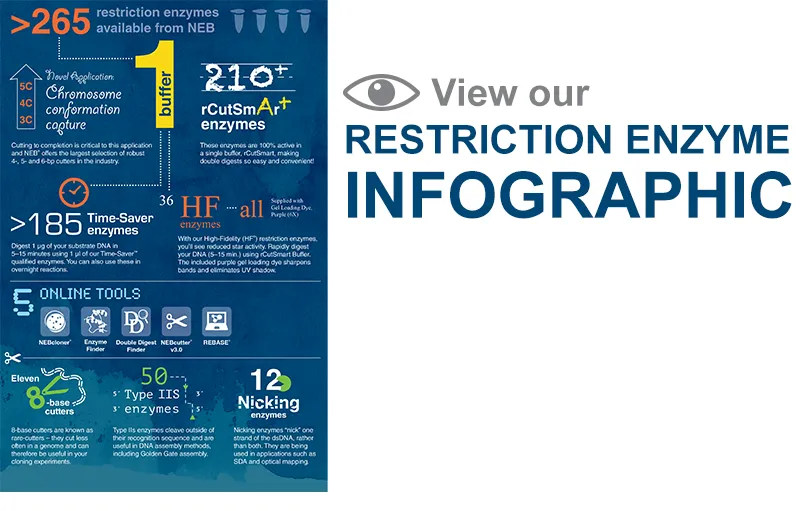
Restriction enzyme infographic

Restriction Endonucleases includes these subcategories:

Restriction Endonucleases: A
Restriction Endonucleases: B
Restriction Endonucleases: C-G
Restriction Endonucleases: H-M
Restriction Endonucleases: N-O
Restriction Endonucleases: P-R
Restriction Endonucleases: S
Restriction Endonucleases: T-Z
HF®, Nicking, Master Mix, Time-Saver & Other
Restriction Endonuclease Buffers & Diluents

FAQs for Restriction Endonucleases

  • How do I create a list of restriction enzymes available from NEB in Geneious software?

Protocols for Restriction Endonucleases

  • Digestion of Agarose-Embedded DNA
  • Standard Digest Using RE-Mix®
  • Double Digest Protocol using Two RE-Mix® Enzymes
  • Optimizing Restriction Endonuclease Reactions
  • Double Digest Protocol using One RE-Mix and One Standard Restriction Enzyme
  • Protocol for Direct Digestion of gDNA during droplet digital PCR (ddPCR)
  • Double Digest Protocol with Standard Restriction Enzymes

Application Notes for Restriction Endonucleases

  • DNA Methylation and Restriction Digests

Tools & Resources

Feature Articles

  • Restriction Endonucleases: Molecular Cloning and Beyond
  • Type II Restriction Enzymes: What You Need to Know | NEB

    Read about Type II restriction enzymes and the distinguishing properties of the four principle subtypes.

  • A Modern Day Gene Genie Sir Richard Roberts on Rebase
  • Restriction Enzyme Cleavage: ‘single-site’ enzymes and ‘multi-site’ enzymes

    Restriction enzymes are proteins used to fragment and clone DNA, but their biological function is to protect bacteria and archaea against viral infections.

  • Whole genome assembly from next generation sequencing data using restriction and nicking enzymes in optical mapping and proximity-based ligation strategies

    High throughput sequencing methods have revolutionized genomic analysis by producing millions of sequence reads from an organism’s DNA at an ever decreasing cost.

Brochures

  • NEB Restriction Enzyme Activity Poster

Web Tools

  • DNA Sequences and Maps Tool
  • REBASE®

Selection Tools

  • Recleavable Filled-in 5' Overhangs
  • Alphabetized List of Recognition Sequences
  • Compatible Cohesive Ends and Generation of New Restriction Sites
  • Dam-Dcm and CpG Methylation
  • Recleavable Blunt Ends
  • Why Choose Recombinant Enzymes?
  • Cleavage Of Supercoiled DNA
  • Enzymes with Nonpalindromic Sequences
  • Enzymes with Multiple Recognition Sequences
  • Isoelectric Points (pI) for Restriction Enzymes
  • Time-Saver™ Qualified Enzymes
  • Type IIS Restriction Enzymes
  • Frequencies of Restriction Sites
  • Interrupted Palindromes
  • Isoschizomers

Troubleshooting Guides

  • Restriction Enzyme Troubleshooting Guide

Usage Guidelines

  • Restriction of Foreign DNA by E. coli K-12
  • Activity at 37°C for Restriction Enzymes with Alternate Incubation Temperatures
  • Restriction Endonucleases - Survival in a Reaction
  • Activity of Restriction Enzymes in PCR Buffers
  • Star Activity
  • NEBuffer Activity/Performance Chart with Restriction Enzymes
  • Digestion of Agarose-Embedded DNA: Info for Specific Enzymes
  • Alteration of Apparent Recognition Specificities Using Methylases
  • Dam and Dcm Methylases of E. coli
  • Restriction Enzyme Diluent Buffer Compatibility
  • Effects of CpG Methylation on Restriction Enzyme Cleavage
  • Cleavage Close to the End of DNA Fragments
  • Restriction Enzymes requiring multi-sites for efficient cleavage
  • Traditional Cloning Quick Guide
  • Restriction Enzymes for Droplet Digital PCR (ddPCR)
  • Double Digests
  • Optimizing Restriction Endonuclease Reactions
  • Restriction Enzyme Tips
  • Heat Inactivation
  • Site Preferences

Posters

  • Crystal Structure of the 8 bp-Specific Restriction Enzyme SwaI (2015)

Publications related to Restriction Endonucleases

  1. Kamps-Hughes, N., Quimby, A., Zhu, Z., Johnson, E.A. (2013) Massively parallel characterization of restriction endonucleases Nucleic Acids Res; 41(11), e119. PubMedID: 23605040, DOI: 10.1093/nar/gkt257
  2. Callahan, S.J., Luyten, Y.A., Gupta, Y.K., Wilson, G.G., Roberts, R.J., Morgan, R.D. and Aggarwal, A.K. (2016) Structure of Type IIL Restriction-Modification Enzyme MmeI in Complex with DNA Has Implications for Engineering New Specificities. PLoS Biol; Apr 15;14(4):e1002442, PubMedID: 27082731
  3. Morgan, R.D., Luyten, Y.A., Johnson, S.A., Clough, E.M., Clark, T.A. and Roberts, R.J. (2016) Novel m4C modification in type I restriction-modification systems. Nucleic Acids Res; Nov, 2;44(19):9413-9425. PubMedID: 27580720
  4. Blow, M.J., Clark, T.A., Daum, C.G., Deutschbauer, A.M., Fomenkov, A., Fries, R., Froula, J., Kang, D.D., Malmstrom, R.R., Morgan, R.D., Posfai, J., Singh, K., Visel, A., Wetmore, K., Zhao, Z, Rubin, E.M., Korlach, J., Pennacchio, L.A. and Roberts, R.J. (2016) The Epigenomic Landscape of Prokaryotes. PLoS Genet; Feb 12;12(2):e1005854, PubMedID: 26870957, DOI: 10.1371/journal.pgen.1005854
  5. Fu YB, Peterson G. W., Dong Y (2016) Increasing Genome Sampling and Improving SNP Genotyping for Genotyping-by-Sequencing with New Combinations of Restriction Enzymes G3 (Bethesda); 6:4, 845-846. PubMedID: 26818077
  6. Shah, S., Sanchez, J., Stewart, A., et al. (2015) Probing the Run-On Oligomer of Activated SgrAI Bound to DNA PLoS One; 10(4), PubMedID: 25880668, DOI: 10.1371/journal.pone.0124783.
  7. Roberts, R.J., Vincze, T., Posfai, J., Macelis, D. (2015) REBASE - A database for DNA restriction and modification: enzymes, genes and genomes Nucleic Acids Res; 43, D298-D299. PubMedID: 25378308
  8. Fomenkov, A., Lunnen, K.D., Zhu, Z., Anton, B.P., Wilson, G.G., Vincze, T. and Roberts, R.J. (2015) Complete genome sequence and methylome analysis of bacillus strain x1 Genome Announc; 3(1), PubMedID: 25700417
  9. Roberts, R.J., Vincze, T., Posfai, J., Macelis, D. (2014) REBASE - A database for DNA restriction and modification: enzymes, genes and genomes Nucleic Acids Res; PubMedID: 25378308
  10. Loenen, W.A., Raleigh, E.A. (2014) The other face of restriction: modification-dependent enzymes. Nucleic Acids Res; 42, 56-69. doi: 10.1093/nar/gkt847

Product Listing