
Protein Concentrators
Protein Concentrators
Protein concentrators are lab devices that use methods like centrifugal force or tangential flow filtration with a semi-permeable membrane to separate and concentrate proteins from a larger liquid volume by allowing smaller molecules to pass through while retaining larger protein molecules. Protein extraction, purification, and cleanup methods frequently produce dilute samples of proteins in buffer matrices incompatible with downstream applications. Thermo Fisher Scientific offers products that utilize two general methods of biomolecule concentration: ultrafiltration and crossflow filtration, also called tangential flow filtration (TFF).
Ultrafiltration centrifugal concentrator devices
Pierce Protein Concentrators are disposable ultrafiltration centrifugal devices used to concentrate, desalt, and buffer exchange biological samples, such as proteins and nucleic acids, readying them for downstream applications with minimal sample handling. They are available in four sizes (0.5, 6, 20, and 100 mL) and offer pH compatibility over a broad pH range (1–9).
Crossflow filtration concentrator devices
Nanocon Crossflow Concentrator is a concentrator that utilizes tangential flow centrifugation technology to concentrate nanosized particles including exosomes, lipid nanoparticles (LNP), and viruses. The 30 nM pore size PE membrane is excellent for nanosized particles, and it fits conveniently in a 250 mL centrifuge adapter.
Pierce Crossflow Filtration Cassettes are membrane-based devices designed for concentrating larger volume sizes and operate via peristaltic pump pressure. They are designed for use in small-volume manufacturing and pilot-scale tangential flow filtration of biological samples yielding high recovery of peptides, proteins, and virus/viral particles. They are used to concentrate large supernatant volumes (0.5–6 L). Additional accessories are available for use with the crossflow filtration cassettes.
Desalting format selection guide
| Ultrafiltration centrifugal devices | Ultrafiltration centrifugal devices | Crossflow filtration devices | ||||
|---|---|---|---|---|---|---|
| Product | Protein Concentrators PES, 0.1–0.5 mL | Protein Concentrators PES, 2–6 mL | Protein Concentrators PES, 5–20 mL | Protein Concentrators PES, 20–100 mL | Nanocon Crossflow Concentrator | Crossflow Filtration Cassettes |
| Sample volume | 0.1–0.5 mL | 2–6 mL | 5–20 mL | 20–100 mL | 40 mL | 0.5–6 L |
| MWCO* / Pore size | 3 kDa, 10 kDa, 30 kDa, 50 kDa, 100 kDa (25 ct) | 3 kDa, 10 kDa, 30 kDa, 50 kDa, 100 kDa (10 ct) | 3 kDa, 10 kDa, 30 kDa, 50 kDa, 100 kDa (10 ct) | 5 kDa, 10 kDa, 30 kDa, 50 kDa, 100 kDa (4 ct) | 30 nm (6 pk) | 3 kDa, 10 kDa, 30 kDa, 50 kDa, 100 kDa |
| Quantity | 10 or 25 | 10 or 24 | 10 or 24 | 4 | 6 | 1 |
Features
Features of protein concentrators
Ultrafiltration centrifugal protein concentrators are designed to remove excess buffer and small molecules while retaining the target proteins, making them excellent for preparing samples for downstream applications. Features include:
Fast
concentrate samples up to 10- to 50-fold in 5–30 minutes (times may vary with different MWCOs)
Flexible
suitable for sample volumes ranging from 100 μL to 100 mL, with a wide range of MWCO offerings
Efficient
recovery of >90% of target sample while removing contaminants or exchange buffers
Convenient
clear markings, wide sample chamber, and removable filtrate chamber make handling simple and easy
Instrument compatible
can be used with standard centrifuges with either fixed-angle or swinging-bucket rotors
Features
Features of crossflow filtration concentrators
Crossflow filtration cassette concentrators offer several key features that make them effective for protein purification workflows:
Scalable
concentrate sample volumes ranging from 0.5–6 L
Fast
many concentration and protein recovery protocols can be completed in 30 minutes or less
Versatile
concentration cassettes are available in five different MWCOs and are compatible with buffers up to pH 13
Efficient
recovery of >99% protein (with 25 mL buffer rinse)
Features
Features of Nanocon concentrators
Nanocon crossflow concentrators are a distinct choice for concentration of biomolecules with features that include:
Advanced technology
utilizes the latest innovations in tangential flow centrifugation to concentrate nanoparticles like viruses and exosomes
Excellent enrichment
engineered to help deliver consistent and reliable results while maintaining sample integrity
Enhanced recovery
optimizes yield through efficient separation processes that reduce sample loss and improve recovery rates
Versatile application
suitable for a wide range of biological fluids, including urine and cell culture media, well-suited for enriching large sample volumes
Features
Features of Nanocon concentrators
Nanocon crossflow concentrators are a distinct choice for concentration of biomolecules with features that include:
Advanced technology
utilizes the latest innovations in tangential flow centrifugation to concentrate nanoparticles like viruses and exosomes
Excellent enrichment
engineered to help deliver consistent and reliable results while maintaining sample integrity
Enhanced recovery
optimizes yield through efficient separation processes that reduce sample loss and improve recovery rates
Versatile application
suitable for a wide range of biological fluids, including urine and cell culture media, well-suited for enriching large sample volumes
Zeba 7K Spin Desalting Columns contain a high-performance size-exclusion chromatography resin that allows for exceptional protein desalting and recovery. When compared to competitors, Zeba 7K desalting columns have excellent protein recovery even at dilute protein concentrations
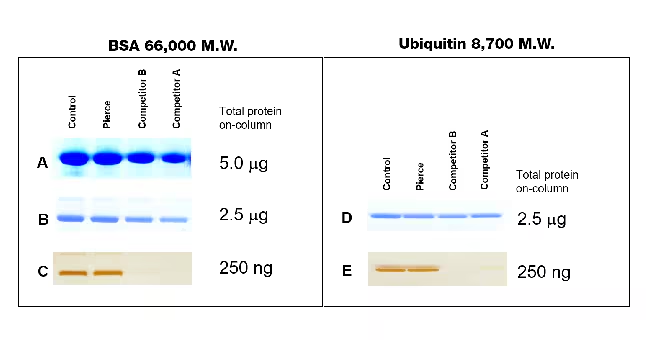
Zeba Micro Spin Desalting Columns, 7K MWCO, recovery performance. BSA and ubiquitin samples of varying concentrations were processed using Zeba Micro Spin Desalting Columns, 7K MWCO, alongside comparable competitor products.
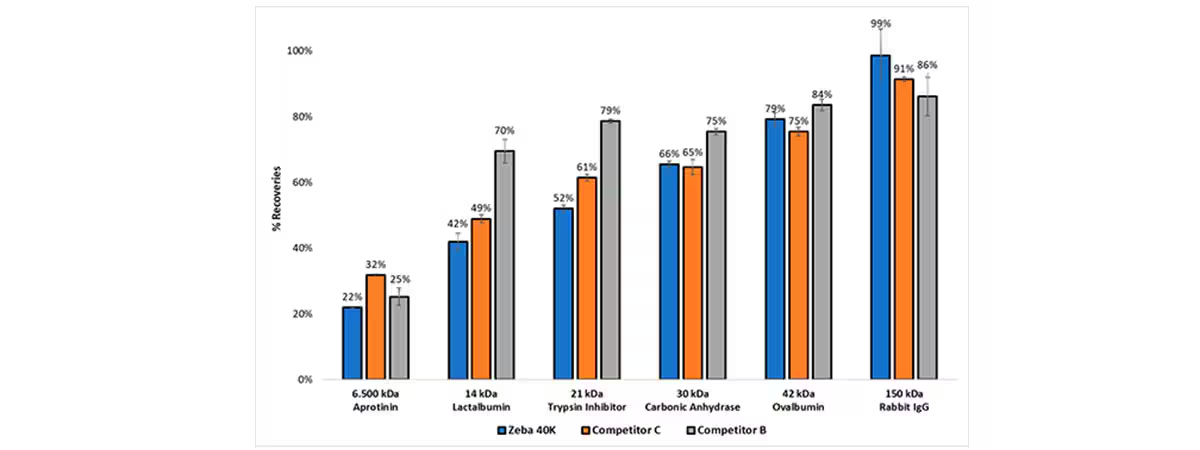
Purified protein samples (0.5 mg/mL) of varying molecular weights were applied individually in 50 µL aliquots in either 0.5 mL Zeba 40K, Competitor C, or Competitor B spin columns equilibrated in PBS. Columns were centrifuged per manufacturers’ instructions for each resin, and the recovered protein (%) in each flow-through sample was determined by BCA protein assay. As opposed to competitor columns, the Zeba 40K resin was more efficient at reducing smaller proteins (evidenced by the lower small protein recovery values).
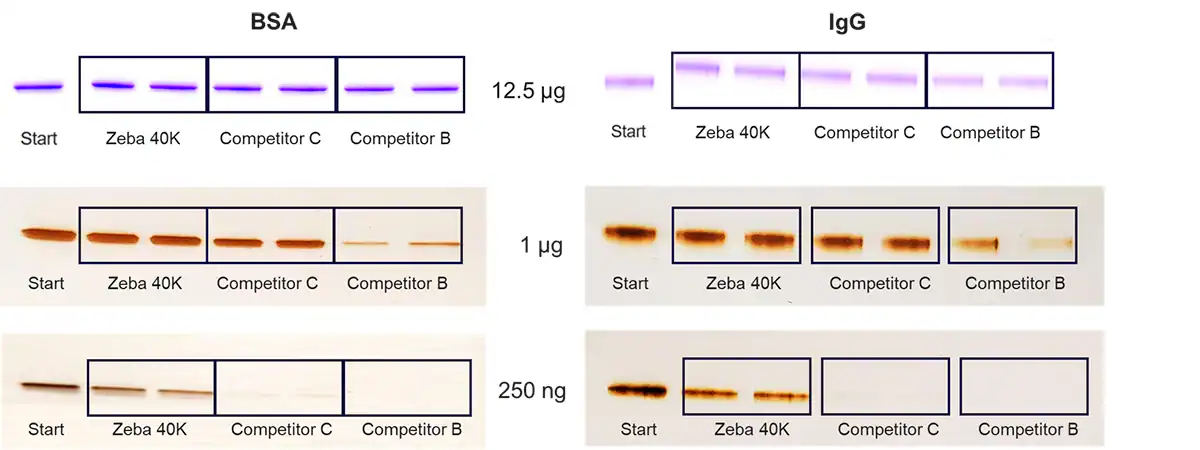
Exceptional sample recovery of low protein loads with Zeba 40K spin columns. BSA and IgG of varying concentrations were applied in 50 µL aliquots to either 0.5 mL Zeba 40K, competitor C, or Competitor B spin columns. All columns were equilibrated with PBS, then centrifuged per manufacturers’ instructions for each resin. Recovered protein (%) in each flow through sample was determined by BCA assay. Flow through samples were performed on SDS-PAGE and stained with either Coomassie Blue or silver stain. Although 12.5 µg total protein load was recovered efficiently by all three resins, lower recoveries were observed with competitor resins at 1 µg and 250 ng protein loads.